Can Autonomous Firefighting Aircraft Stop Wildfires Before They Spread?
Seneca Founder and CEO Stuart Landesberg joins All Things Wildfire to explain how autonomous aerial suppression could change wildfire initial attack, nighttime operations, insurance risk and community protection.
Wildfire detection is getting faster.
Across the American West, camera networks, satellites, infrared sensors and other technologies are increasingly capable of identifying smoke and new ignitions earlier than ever.
But detecting a wildfire is only part of the problem.
What happens after the fire is detected?
That question is at the center of our latest episode of All Things Wildfire, featuring Stuart Landesberg, Founder and CEO of Seneca, a resilience technology company developing autonomous aerial systems designed specifically for wildfire response.
Seneca’s goal is ambitious: dramatically shorten the time between detection and suppression.
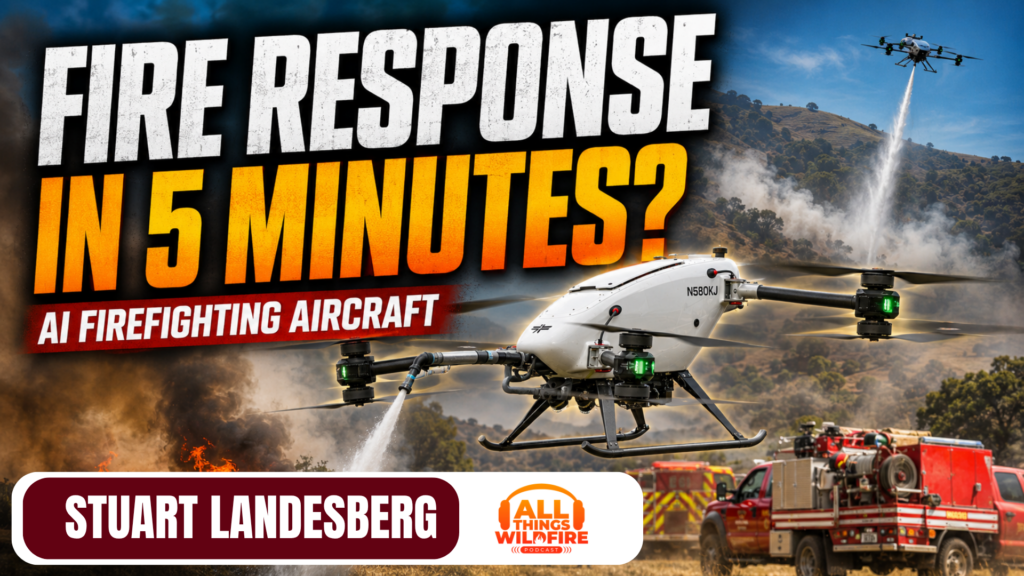
Rather than waiting for a fire engine to reach difficult terrain or for a helicopter and crew to become available, Seneca is developing autonomous aircraft that can be stationed near high-risk areas, launch rapidly, navigate toward an approximate fire location, identify the precise heat source and begin suppression.
In the episode, Landesberg describes a target response time of roughly three to five minutes from detection.
That could fundamentally change what “initial attack” looks like.
The Problem Seneca Is Trying to Solve
Landesberg’s entry into wildfire technology began personally.
Living in an extremely high-fire-risk area of Northern California, he experienced the growing insurance problem firsthand after his homeowners insurance was canceled. He was later quoted a premium in the non-admitted market equivalent to roughly 2% of his home’s value per year.
Instead of thinking only about transferring that risk through insurance, he began asking fire professionals a different question:
What could he do to actually reduce the probability of the home burning?
Home hardening was an obvious part of the answer.
But another theme repeatedly emerged: get to the fire while it is still small.
Landesberg says he was surprised by how difficult that can still be. In inaccessible areas, firefighters may have to drive as far as possible, leave the engine and continue on foot carrying equipment into the terrain.
That can turn initial response into a 20-minute, one-hour or even longer operation depending on access.
And when a fire is growing rapidly, minutes matter.
Seneca’s Five-Aircraft Wildfire Strike Team
Seneca’s answer is what Landesberg calls a five-aircraft strike team.
In the configuration discussed during the episode, each aircraft weighs roughly 400 pounds and carries approximately 20 gallons of water along with firefighting concentrate.
Depending on the suppressant being used, Landesberg says that water can be converted into substantially more finished firefighting foam. Seneca designed the five-aircraft approach so several smaller autonomous aircraft can create an ongoing suppression cycle rather than relying on a single large aircraft.
Seneca’s current system is built around autonomous navigation, onboard sensors and AI-assisted targeting. Its product materials describe infrared and video sensing, autonomous obstacle avoidance and suppression systems capable of accounting for wind when targeting a fire.
But Landesberg is careful about the role of artificial intelligence.
The technology matters, but the objective isn’t simply to build an impressive AI system.
The objective is much simpler:
Get suppressant onto a developing fire as quickly, safely and accurately as possible.
From Wildfire Detection to Autonomous Suppression
One of the most interesting parts of the conversation is Landesberg’s explanation of how an actual response could work.
Seneca does not need to own the wildfire detection layer.
A new ignition could potentially originate from a camera network, satellite system, dispatch center or other detection source.
That detection provides an approximate GPS coordinate.
From there, a Seneca aircraft can be launched toward the location.
Once in the area, onboard infrared sensors, RGB cameras, LiDAR and radar help the aircraft locate the actual heat source and safely navigate to it.
The system then evaluates conditions—including wind speed and direction—to determine an attack path.
After the first aircraft makes its suppression pass, information collected during that mission can help inform the aircraft that follow.
Landesberg compares the concept to a technologically advanced bucket brigade: aircraft cycle toward the fire, make a suppression pass, return for suppressant and battery replacement, and reenter the operation.
Why Autonomous Aircraft Matter in Dangerous Conditions
Wildfire aviation involves an unavoidable problem: the conditions when aerial support is needed most can also be some of the most dangerous conditions to fly in.
Landesberg makes an important distinction.
Seneca isn’t claiming an aircraft can operate regardless of conditions. In extreme winds, aerial suppression of any kind may become impossible.
But unmanned aircraft change the risk calculation.
If conditions deteriorate and an autonomous aircraft is lost, equipment has been lost.
When a crewed helicopter is placed into marginal conditions, human lives are at risk.
That distinction could allow fire agencies to use autonomous aircraft for missions they may otherwise hesitate to assign to personnel.
And that leads to another major advantage.
Fighting Wildfires at Night
Seneca’s aircraft are designed for nighttime operations.
Landesberg explains that the aircraft rely heavily on GPS, infrared sensing and LiDAR rather than requiring a pilot to visually navigate the terrain from inside an aircraft.
That opens another potential window for wildfire response.
Some traditional firefighting aviation resources have limited nighttime capabilities. Seneca’s system is intended to operate whether an ignition occurs at 2:00 in the afternoon or 2:00 in the morning.
During the interview, Landesberg estimates roughly 20 minutes of flight time under a full payload, depending on factors including elevation, temperature, wind and terrain. Without the heavy suppression payload, reconnaissance missions can last significantly longer.
Seneca Isn’t Trying to Replace Firefighting Helicopters
This distinction matters.
Seneca is not positioning autonomous aircraft as a replacement for traditional firefighting aviation.
The primary opportunity is getting to an ignition before larger aerial resources arrive.
If a helicopter is 30 minutes away but autonomous suppression can reach the fire several minutes after detection, the objective is to prevent a quarter-acre fire from becoming a much larger incident while other resources are still responding.
Once crewed aircraft enter the airspace, Landesberg says Seneca expects to yield and coordinate with the incident command structure.
He describes the integration of autonomous aircraft and human pilots as a gradual “crawl, walk, run” process.
The aircraft can also serve other roles during larger incidents.
Those could include moving supplies to crews, retrieving materials, conducting infrared reconnaissance, performing mop-up, identifying hot spots and repeatedly applying suppressant to areas at risk of rekindling.
The Hidden Wildfire Danger After the Flames Have Passed
One of the most compelling moments of the episode comes from an experience Allied Disaster Defense had during the Palisades Fire.
While traveling through an affected neighborhood, the team was asked by an insurance broker to check whether several client properties were still standing.
At one surviving property, the team noticed smoke coming from underneath a railroad tie only feet from the home.
The surrounding fire had already passed.
The house had survived.
But underneath that railroad tie was still enough heat and active fire to potentially threaten the structure again.
The crew sprayed the area and eventually had to dig underneath it to fully address what was burning.
That is exactly the type of post-fire problem autonomous infrared-equipped aircraft could potentially help identify.
Rather than asking firefighters to repeatedly walk large burned areas looking for remaining heat sources, aircraft can scan the area from above, locate hot spots and support cold trailing and mop-up operations.
Landesberg also discusses potential future applications including structure protection, retardant lines and targeted treatment around critical infrastructure.
Aspen Fire Becomes Seneca’s First Fire Department Customer
The concept has now moved beyond the testing stage.
Aspen Fire Protection District is becoming the first U.S. fire department to acquire Seneca’s autonomous aerial suppression system.
Seneca announced a five-year, multi-million-dollar partnership that will bring a five-aircraft Strike Team to Aspen.
The company says the system is intended to support rapid initial attack, prescribed burns, mop-up and other fire operations.
The partnership is particularly significant because Aspen does not operate the type of large traditional helicopter program available to some major metropolitan fire agencies.
During the episode, Landesberg estimates that establishing a comprehensive helicopter program can require tens of millions of dollars in infrastructure before considering the substantial ongoing staffing, maintenance and operating costs.
An autonomous system creates a very different economic model.
Aspen Fire’s own records show the district has been working with Seneca on testing and development and later accepted a donation from the Aspen Wildfire Foundation to support the program subject to final negotiations and legal requirements.
Could HOAs Have Their Own Aerial Wildfire Defense?
For homeowners, insurance professionals and high-fire-risk communities, one of the most interesting parts of Seneca’s model may be what happens outside municipal fire departments.
Landesberg says Seneca is already having conversations with HOAs and other private organizations.
Consider a large community located in a high-fire-severity zone.
If an ignition starts tens of miles away and develops into a major wildfire, an HOA’s own suppression resources aren’t going to stop the incident.
But a fire starting one, two or three miles from the community presents a different problem.
Those first several minutes may determine whether the ignition remains manageable or becomes something requiring hundreds of firefighters, aircraft and heavy equipment.
A locally positioned autonomous suppression system could potentially provide another layer between detection and the arrival of regional or state resources.
The Insurance Implications Could Be Just as Important
This is where wildfire technology and insurance increasingly intersect.
Insurance carriers already evaluate factors such as vegetation, construction characteristics, defensible space, distance to fire resources and community-level wildfire protection.
Landesberg believes response time itself should become another measurable risk variable.
If one community can potentially attack a nearby ignition within minutes while another community may wait significantly longer for suppression resources, those properties do not necessarily have the same wildfire exposure.
For homeowners and HOAs, that creates an important question:
Could investments in mitigation, detection and rapid suppression eventually translate into better insurability or pricing?
Landesberg believes insurance can help create the economic incentive necessary to accelerate these investments.
If homeowners and communities that demonstrably reduce risk are rewarded for doing so, wildfire protection becomes more than simply an expense—it becomes part of a measurable risk-management strategy.
What Does a Seneca System Cost?
The technology isn’t inexpensive, but it is being designed as an alternative to the economics of conventional aviation programs rather than as a consumer drone.
During the episode, Landesberg describes Seneca’s typical partnerships as five-year agreements in the low single-digit millions for a five-aircraft system and mobile air operations base.
He also gives a rough range of approximately $100,000 to $250,000 per aircraft per year, depending on configuration and customer requirements.
Seneca’s model includes support such as warranties and hardware refreshes during the contract period.
Specifications and commercial pricing can change, so organizations considering a system should obtain current information directly from Seneca.
Wildfire Protection Will Require an Ecosystem
Perhaps the most important takeaway from the episode is that Seneca isn’t being presented as a silver bullet.
Wildfire resilience will still require home hardening, defensible space, vegetation management, early detection, professional firefighters, aircraft, community planning, insurance incentives and new technologies working together.
Seneca is attempting to add another tool to that system:
an autonomous aerial resource that can be positioned close to risk and dispatched almost immediately.
The larger question isn’t whether robots will replace firefighters.
They won’t.
The more interesting question is:
How many dangerous, slow or inefficient jobs currently performed by people could be handed to machines so firefighters can focus on the work where human judgment matters most?
That is the future Stuart Landesberg and Seneca are trying to build.
And Aspen may give the wildfire industry its first real look at what that future looks like in operation.
About Stuart Landesberg
Stuart Landesberg is the Founder and CEO of Seneca, a resilience technology company developing autonomous aerial systems and AI-driven tools for wildfire response. Seneca’s team includes technology and fire-service leaders, including former U.S. Fire Administrator Dr. Lori Moore-Merrell as Fire Technology Advisor and Palantir CFO David Glazer as a founding investor. Seneca has also worked with fire leaders and development partners in California and Colorado as it develops its autonomous suppression platform.
Resources:
Learn More about Seneca’s Autonomous Drones
Watch the full episode of All Things Wildfire to hear how autonomous aviation could change wildfire response for fire agencies, HOAs, insurers and high-risk communities.