Wildfire Insurance and Mitigation: How Homeowners and HOAs Can Improve Insurability
For many homeowners, HOA boards, and property managers, wildfire insurance can feel like a black box.
A property owner may clear vegetation, replace vulnerable vents, improve the roof, or invest in defensible space—yet still struggle to understand whether that work will affect eligibility, renewal, coverage, or premium.
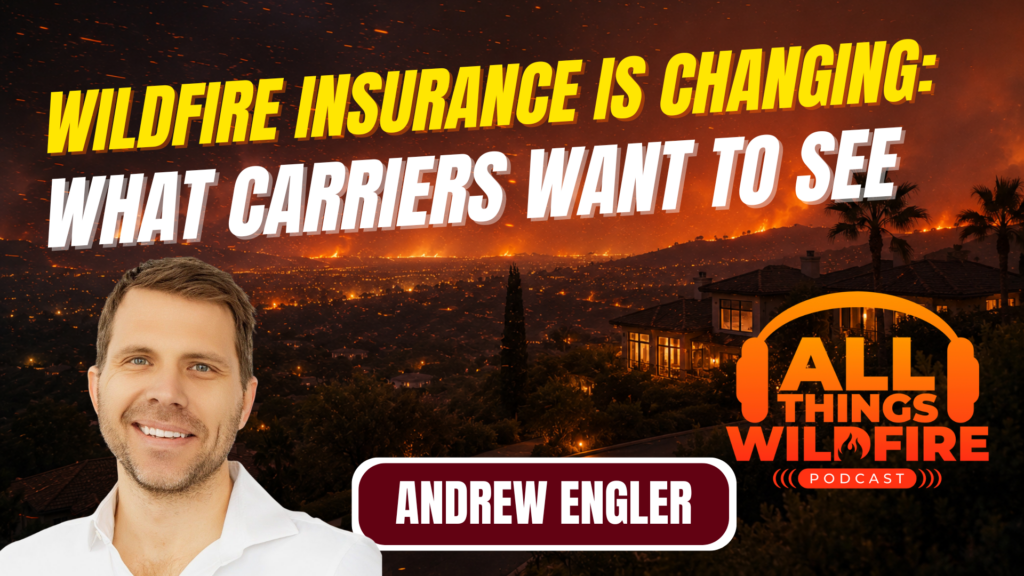
In a recent episode of All Things Wildfire, we spoke with Andrew Engler of Rock Rose Risk about how that process is changing. Rock Rose Risk is a retail insurance broker focused specifically on wildfire. The company works with 27 carriers across homeowners and commercial properties, with the goal of translating completed mitigation work into information that insurance carriers can evaluate.
Engler described the current state of wildfire insurance as the “Wild West days.” The market is still developing consistent methods for measuring how individual improvements, neighborhood projects, utility work, and fuel reduction affect the probability of loss.
But the direction is becoming clearer: wildfire mitigation is most valuable when it is measurable, maintained, documented, and communicated to the right insurance markets.
Insurance carriers are looking at both the neighborhood and the property
One of the most important concepts discussed in the episode is the difference between macro mitigation and micro mitigation.
Macro mitigation looks beyond the property line
Macro mitigation evaluates the conditions surrounding a property or community. This may include:
- Fuel breaks and vegetation management projects
- Terrain, canyons, slopes, and prevailing fire behavior
- Utility line hardening
- Road access and evacuation routes
- Fire department access and suppression capability
- The condition of nearby open space
- Community-wide mitigation participation
A home may be well maintained, but its risk is still influenced by the landscape and structures surrounding it. A carrier may therefore need to understand whether a nearby hillside has been treated, whether utility infrastructure has been hardened, and whether firefighters would have a realistic opportunity to slow or suppress a fire before it becomes a structure-to-structure event.
Micro mitigation focuses on the individual parcel
Micro mitigation examines the work completed at the home or building itself. Engler specifically discussed measures such as:
- Zone 0 clearance immediately around the structure
- Class A roofing
- Ember-resistant vent protection
- Parcel-level vegetation management
- Improvements completed across neighboring homes
The goal is not to claim that a home cannot burn. It is to demonstrate that the property and surrounding community have reduced the conditions that allow a wildfire to rapidly transition into an uncontrollable structure fire.
The practical lesson is that wildfire resilience cannot be evaluated through a single checklist item. A strong risk profile combines property-level improvements with larger community and infrastructure work.
Can wildfire mitigation lower insurance premiums?
It can—but homeowners should distinguish between becoming eligible for coverage and receiving a direct premium reduction.
In some cases, mitigation may help a property qualify for insurance that would otherwise be unavailable. In other cases, documented work may support a lower rate. The result depends on the carrier, location, surrounding exposure, available market capacity, policy structure, and quality of the supporting data.
Engler reported that the average discount across Rock Rose Risk’s client portfolio was approximately 35 percent, with some HOA communities experiencing substantial reductions.
That figure is specific to Rock Rose Risk’s experience and should not be interpreted as a guaranteed outcome. A homeowner may complete meaningful mitigation and still encounter limited carrier availability, particularly in areas with concentrated wildfire exposure.
The broader takeaway is that mitigation can create a stronger insurance case—but the work must be translated into evidence an underwriter can understand.
Why Firewise and Fire Safe Council participation matters
Firewise and Fire Safe Council designations are often discussed as if the designation itself is the entire benefit.
Engler offered a more useful interpretation.
The value is not merely a “stamp.” It is evidence that a community has organized leadership capable of educating residents, coordinating projects, maintaining participation, and implementing mitigation at scale.
That leadership becomes especially valuable when an insurance broker needs to demonstrate that a neighborhood is not treating wildfire risk as a one-time project. A functioning community organization can help collect documentation, communicate annual maintenance requirements, coordinate fuel reduction, and encourage participation among residents.
Engler compared community participation to a technology adoption curve. There will be early adopters, a larger middle group, and a smaller number of residents who act later. His practical focus is on building a meaningful concentration of completed work rather than waiting for perfect participation from every homeowner. He referenced approximately 80 percent as a working objective, not as a universal carrier requirement or formal underwriting threshold.
For HOA boards and property managers, that means progress should not stop simply because 100 percent participation has not yet been reached.
Affordability is what turns awareness into action
Most people living in wildfire-prone areas already know that wildfire is a concern. Awareness alone, however, does not necessarily result in action.
The challenge is often affordability.
Removing vegetation, replacing a roof, installing ember-resistant vents, or completing larger community projects can be expensive. Engler emphasized that homeowners are more likely to participate when the financial equation is clear—particularly when mitigation can be connected to improved insurance options or measurable savings.
The episode also explores emerging financing models, including lending products intended to spread mitigation costs over time. Engler’s larger point is that wildfire resilience should be treated as an infrastructure problem. Homes, vegetation, roads, utilities, and other physical systems degrade and change over time. Maintaining them requires a practical, repeatable financial model.
The best mitigation plan is not necessarily the most expensive plan. It is the one that prioritizes the work producing the greatest risk reduction and can be maintained year after year.
Wildfire mitigation is not a one-time project
Some improvements are relatively permanent. A properly installed Class A roof or ember-resistant vent system may provide value for years.
Other conditions change continuously.
Vegetation grows back. Leaves and debris accumulate. Trees become stressed or damaged. Neighboring properties change. Fuel reduction projects require maintenance. New construction can affect access and exposure.
Engler compared this process to maintaining roads and other infrastructure. A property that receives no maintenance for many years will gradually become more vulnerable, even if meaningful work was completed previously.
This is why carriers increasingly need updated information. Engler noted that older satellite imagery may not provide enough detail, particularly when tree cover obscures property conditions. Without credible ground-level data, an underwriter may default to the more conservative interpretation of the risk.
What should homeowners and communities document?
Based on the episode’s emphasis on current, ground-level evidence, a useful mitigation record can include:
- A baseline wildfire risk assessment with dated photographs.
- A prioritized list of recommended improvements.
- Before-and-after photographs of completed work.
- Contractor invoices, product information, and completion dates.
- Documentation of vent, roof, gutter, deck, fence, and Zone 0 improvements.
- Annual vegetation and fuel-maintenance records.
- Maps or reports showing community fuel breaks and larger projects.
- Firewise, Fire Safe Council, or other relevant community documentation.
- A concise summary that a broker can present to multiple carriers.
Documentation does not guarantee a discount or policy. It gives the homeowner, HOA, broker, and underwriter a more accurate record than an outdated aerial image or broad geographic assumption.
Admitted, non-admitted, and FAIR Plan coverage
The episode also addresses a common source of confusion: the difference between admitted carriers, non-admitted carriers, and the California FAIR Plan.
Rock Rose Risk works with a combination of admitted and non-admitted carriers. Engler cautioned against assuming that every non-admitted carrier is the same. Some are large, well-capitalized companies with significant underwriting histories, while others may require closer scrutiny.
For property owners, the label alone should not be the only consideration. Financial strength, coverage language, exclusions, limits, claims practices, and the carrier’s understanding of wildfire mitigation all matter.
Engler described the California FAIR Plan as an insurer of last resort rather than a permanent replacement for a competitive insurance market. His concern centers on the concentration of wildfire exposure within one mechanism. When too much risk is concentrated in one place, there may not be enough premium to sustainably support a severe, widespread loss.
He also reported seeing signs of a softer wildfire insurance market, with additional carriers considering wildfire business and rates easing in some circumstances. That observation reflects his experience at the time of the conversation; availability and pricing remain property- and market-specific.
Why one carrier cannot insure an entire neighborhood
Even if a group of homes is well hardened, one carrier may be unable to insure every property in that neighborhood.
This is known as aggregation risk.
A carrier must consider the possibility that one event could damage many insured properties at the same time. Even when the probability is low, concentrating too much exposure in one geographic area can create a loss large enough to threaten the carrier’s ability to pay claims elsewhere.
Engler explained that a carrier may view 50 homes as excellent individual risks while still being unable to write all 50. A more sustainable outcome may involve several carriers dividing the neighborhood’s policies among them.
This helps explain why two similar homes in the same community may receive different results. The issue may not be the quality of the second home. One carrier may simply have reached its capacity for that area.
For HOAs, the objective should therefore be to make the community attractive to multiple carriers, not to depend on a single insurer.
Utility hardening and community infrastructure can change the risk story
Individual home hardening is only one part of wildfire resilience.
Engler discussed the Grass Valley area as an example of how utility line hardening and fuel reduction can affect carrier interest. The important step is translating those projects into underwriting information:
- What work was completed?
- Where was it completed?
- How did it affect potential ignitions?
- Did it create a more defensible or suppressible environment?
- What do local fire officials know about historical fire behavior?
- Where are the most likely ignition and spread corridors?
Rather than relying exclusively on a generalized risk score, Rock Rose Risk may bring local fire leadership, utility information, fire history, and mitigation data into the conversation with carriers.
That creates a more complete picture of whether an area is simply exposed to wildfire—or whether meaningful work has made a future fire more manageable.
The broker’s role is to translate mitigation into insurance language
Completing wildfire mitigation does not automatically mean an underwriter will see, understand, or credit the work.
That is where the brokerage relationship becomes critical.
A wildfire-informed broker can organize the property and community data, explain why specific improvements matter, identify carriers that understand the work, and present the risk to more than one market.
Engler described the broker as one of the most important links in the process because the broker communicates directly with the insured and can explain what needs to be done, how it may be financed, and how the completed work should be presented.
For homeowners, the question should not simply be:
“Did I complete the work?”
It should also be:
“Has the completed work been documented and presented to carriers that are capable of recognizing it?”
What homeowners, HOAs, and property managers should do next
The episode offers a practical path forward.
1. Establish a baseline
Begin with a qualified wildfire risk assessment. Identify ember-entry points, combustible materials, vegetation, slopes, access limitations, and surrounding community exposure.
2. Separate permanent improvements from annual maintenance
A roof or vent system may be a long-term improvement. Vegetation, debris, fuel continuity, and defensible space require regular review.
3. Prioritize by risk—not appearance
A property does not need to be “moonscaped.” The objective is to identify the improvements that produce meaningful risk reduction while preserving the property’s appearance and usability.
4. Keep a mitigation record
Maintain photographs, invoices, assessment reports, product specifications, maintenance dates, and community project information in one organized file.
5. Coordinate at the community level
HOAs and Firewise leaders should track participation, communicate priorities, organize recurring maintenance, and document larger fuel-reduction efforts.
6. Ask the broker to reevaluate the market
Property owners who have completed mitigation but have seen no improvement in their insurance position should ask whether updated information has been presented to multiple carriers.
7. Build a property that several carriers would want to insure
Because of aggregation limits, even a strong carrier may be unable to write every property in one area. The long-term objective is to create a risk profile that can be presented competitively across several markets.
Proactive wildfire protection is about more than insurance
The episode closes with a message of cautious optimism.
Engler encourages homeowners not to accept the assumption that nothing can be done simply because a property is located in a high wildfire-risk area. Some properties may require significant work, and not every project will immediately produce a lower premium. But updated mitigation, stronger community organization, and better documentation can create new options.
Insurance is only one part of the outcome.
The deeper purpose of wildfire mitigation is to give the structure, the community, first responders, and—most importantly—the people living there a better fighting chance.
At Allied Disaster Defense, we help homeowners, HOA boards, property managers, and insurance professionals identify property vulnerabilities and prioritize practical mitigation. Our assessments examine ember exposure, vegetation, Zone 0, vents, roofs, decks, fences, slopes, access, and other property-specific conditions.
From there, we can help develop a mitigation plan, coordinate appropriate improvements, document completed work, and evaluate whether strategic long-term fire-retardant treatment should be part of a broader wildfire defense strategy.
Insurance eligibility, underwriting, pricing, and discounts vary by carrier and property. Mitigation can reduce risk but does not guarantee coverage, premium savings, or that a structure will survive a wildfire. Fire-retardant treatment is one protective layer and is not a guarantee against loss.
FAQ section
Can wildfire mitigation lower homeowners insurance premiums?
Mitigation may improve eligibility, support renewal, or help a broker pursue better pricing. Andrew Engler reported an average discount of approximately 35 percent across Rock Rose Risk’s portfolio, but individual results vary and no discount is guaranteed.
What is the difference between macro and micro wildfire mitigation?
Macro mitigation examines neighborhood and regional conditions such as fuel breaks, utility projects, terrain, road access, and fire-department capability. Micro mitigation examines the individual parcel, including Zone 0, roofing, vents, vegetation, decks, fences, and other structure-specific vulnerabilities.
Does being a Firewise community guarantee an insurance discount?
No. A Firewise designation may be valuable because it demonstrates community organization, leadership, and ongoing mitigation activity. Whether a carrier provides a discount depends on its underwriting rules and the other characteristics of the property and community.
Why should wildfire mitigation be documented?
Carriers may not know that conditions have improved unless the work is documented and presented. Updated photographs, invoices, assessments, maintenance records, maps, and project reports can provide a clearer picture than older satellite imagery or broad geographic assumptions.
Why can’t one insurance carrier cover every home in a hardened community?
Carriers limit the number of policies they write in one area because a single wildfire could affect many properties simultaneously. This aggregation risk means that even well-mitigated communities may need several carriers to share the exposure.
How often should a wildfire risk assessment be updated?
Permanent improvements should be documented when completed, while vegetation, fuel conditions, access, and surrounding exposures should be reviewed regularly. Annual reviews are especially useful for properties with significant landscaping, slopes, open-space exposure, or changing neighboring conditions.