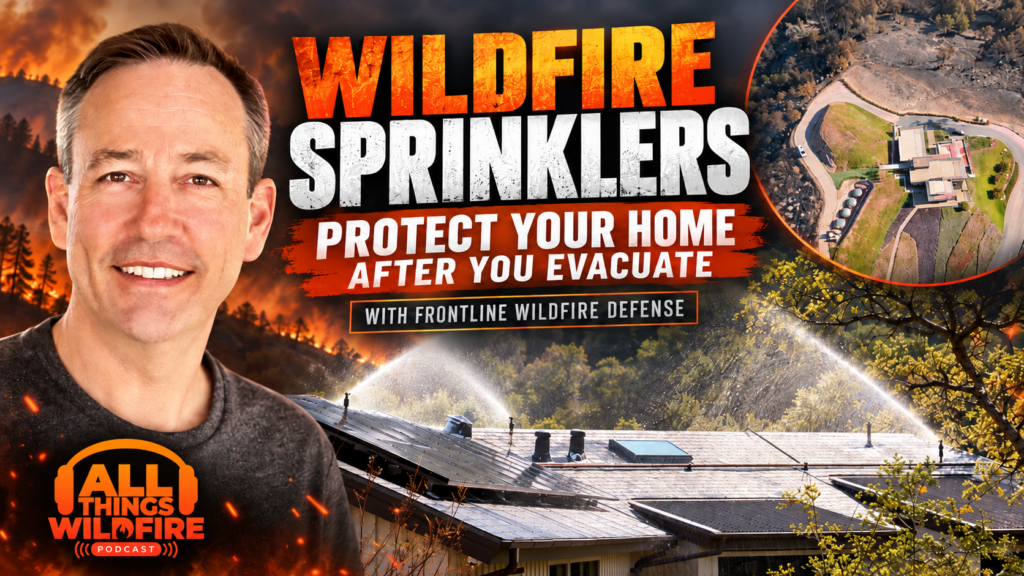
Can Wildfire Sprinklers Save Your Home? Inside Frontline Wildfire Defense
You have evacuated. Your family is somewhere safe. But what is still working to protect your home?
That question drives this episode of All Things Wildfire, as host O.P. Almaraz welcomes Harry Statter, founder and CEO of Frontline Wildfire Defense.
Their conversation goes beyond whether sprinklers can spray water on a house. It examines how homes become vulnerable to ignition, what happens when power and water systems are disrupted, and why protecting a property requires more than one product or precaution.
From ember-resistant vents to automated exterior sprinklers, the central message is consistent: there is no silver bullet. The goal is to understand a property’s vulnerabilities and combine measures that address them.
Why Frontline focuses on preventing ignition
Harry’s background is in landscape ecology, forestry, and defensible-space work. He explains that studying structure losses—including commercial buildings surrounded by large parking lots—pushed him to look more closely at the role of embers.
His focus is not limited to vegetation. Patio furniture, decking, vehicles, garbage cans, and other combustible materials around a home can become part of the fire exposure.
Frontline’s approach, as Harry describes it, is to wet vulnerable materials before embers ignite them. Rather than waiting for a fire to develop beside a structure, the system is intended to reduce the opportunity for that ignition to happen.
As Harry puts it:
“We’re not suppressing a fire, we’re avoiding a fire.”
Wildfire sprinklers do not replace home hardening
One of the most important moments comes when O.P. asks about homeowners who want sprinklers without addressing other vulnerabilities.
Harry’s answer is direct: a comprehensive approach still matters. Open windows and unprotected vents remain pathways for embers, regardless of what is happening outside.
In fact, Harry says ember-resistant vents would be his first improvement at his own home.
That distinction matters throughout the conversation. Exterior sprinklers are discussed as an additional layer of protection—not permission to ignore vents, combustible materials, or other weak points around the structure.
How automated wildfire sprinklers work
Harry explains that Frontline’s platform combines satellite, camera, sensor, weather, and fire-service data to track threats.
Customers can opt into automated activation. When the platform identifies a threat, Harry says it sends a notification that the system will activate in 10 minutes, with an opportunity to accept or decline.
The system mixes water with Class A foam, which Harry describes as biodegradable, to improve wetting and reduce the amount of water needed. The objective is to build moisture in vulnerable materials around the home before embers arrive.
The accompanying app also communicates with homeowners during the event, helping them understand the threat and prepare to leave. The protection strategy is designed to operate while people get out of harm’s way.
What happens when wind, water, or power becomes a problem?
O.P. asks the practical questions homeowners are likely to have: What happens when strong winds push the spray? What happens if municipal water pressure drops? And how does the system keep operating during a power outage?
Harry describes overlapping sprinkler coverage and targeted spray patterns intended to account for wind-driven exposure.
On water use, he cites Los Angeles deployments that operated between six and twelve gallons per minute. He also discusses an optional backup-water setup that can draw from a pool when municipal pressure drops, along with other potential sources such as tanks.
For power and communications, Harry describes battery backup and solar charging for the controller, plus Wi-Fi, cellular, and satellite connectivity.
These details make the discussion especially useful for homeowners evaluating a system: the conversation addresses not just normal operation, but the failures and disruptions that can accompany a wildfire.
Frontline’s reported results during the Los Angeles fires
Harry reports that Frontline protected 59 homes during the Los Angeles fires and describes a 96% effectiveness rate, while noting that the properties experienced different levels of exposure.
He also discusses situations where protected homes remained standing while surrounding properties were lost.
These are Frontline’s reported results from the interview—not a guarantee of what will happen at any individual property during a future fire. They are part of a broader conversation about evaluating what works, understanding limitations, and learning from actual wildfire exposure.
Why the conversation extends to insurance and entire communities
The episode also explores Frontline’s relationship with insurers, including the Stand Insurance partnership Harry describes, and why property protection matters to both homeowners and insurance companies.
O.P. and Harry then discuss the limits of protecting a single home when neighboring structures and combustible materials remain vulnerable.
Harry shares an example involving a 151-unit condominium community in Santa Clarita, where the approach considers individual buildings, porches, garages, and other locations where ignition could lead to wider losses.
The emphasis is on identifying exposure throughout a community rather than assuming protection begins and ends at the property line.
The takeaway: understand the exposure before choosing the solution
The conversation closes with a point both men return to repeatedly: homeowners need to understand how their particular property could ignite.
Harry calls for better feedback on the effectiveness of wildfire solutions. O.P. reinforces that message by acknowledging that some homes treated with fire retardant during the Palisades response were still lost.
Neither presents a single product as the complete answer. Instead, they encourage a more informed approach: identify the vulnerabilities, understand where individual measures have limitations, and build a combination of protections around the actual property.
Resources: